X112 INSIGHT · PRIVATE AVIATION
ACJ TWOTWENTY: IS THE A220 CHANGING THE BUSINESS-JET EQUATION?
Why a larger cabin, intercontinental range and airline-derived economics are creating a different proposition in business aviation.
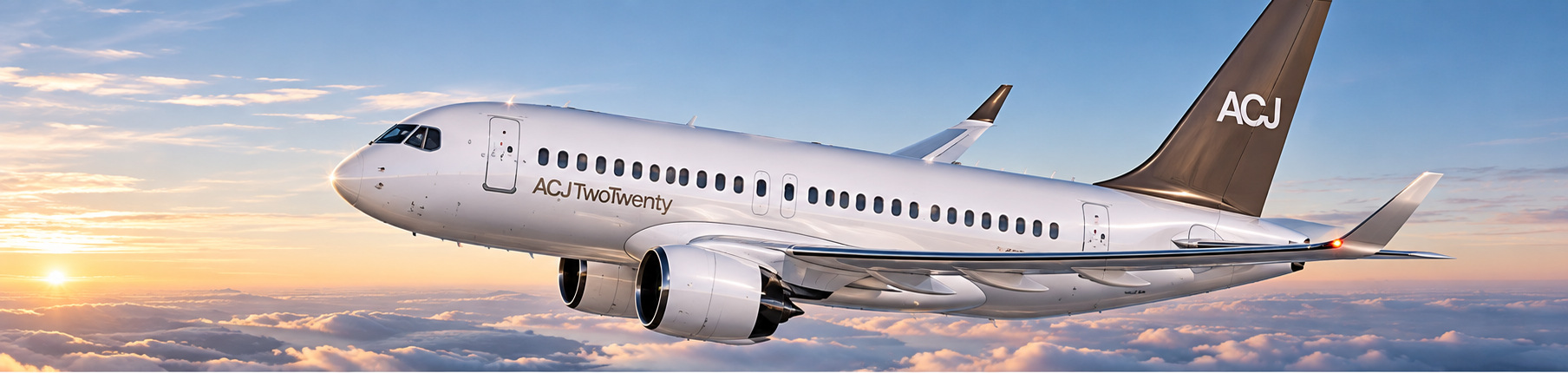
A different proposition in the business-jet market.
The ACJ TwoTwenty sits between conventional purpose-built ultra-long-range business jets and larger traditional bizliners. Based on the A220-100 platform, it combines an airliner-scale fuselage with a business-aviation cabin and an intercontinental mission profile.
The cabin is the obvious differentiator.
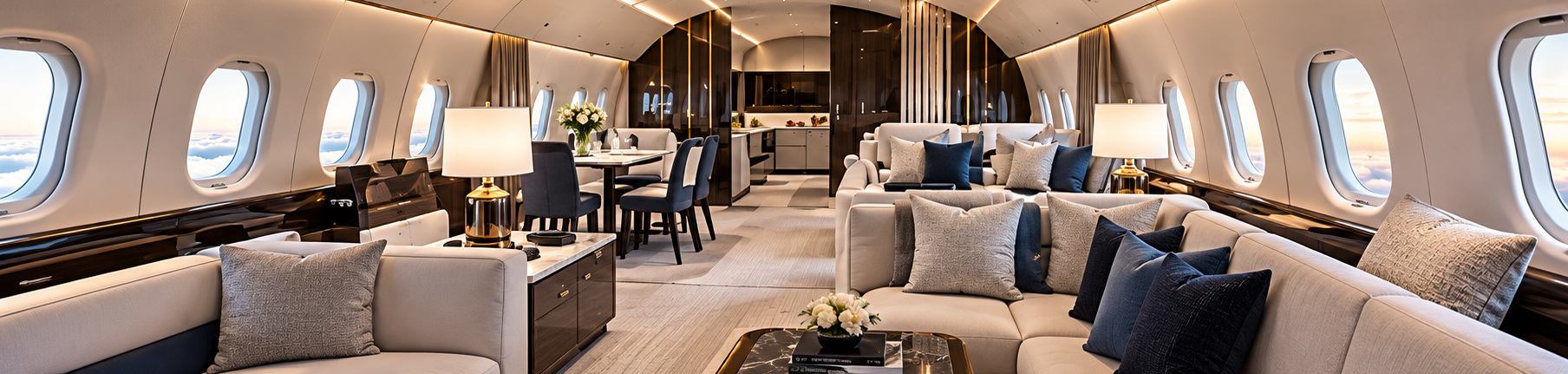
Airbus specifies 73 m² (786 ft²) of cabin floor area, a 3.3 m cabin width and 2.1 m cabin height, arranged around six living zones. That changes the comparison from simply counting seats to deciding how much dedicated space is available for work, dining, meetings, rest and privacy.
Range without moving to the largest bizliners.
Airbus publishes a maximum range of 5,650 nm and describes the aircraft as capable of more than 12 hours of non-stop flying. This places a large cabin into a mission envelope capable of covering many intercontinental city pairs, although actual range always depends on payload, weather, reserves, routing and operating conditions.
The engine is a major part of the efficiency equation.
A significant part of the ACJ TwoTwenty efficiency proposition comes from its Pratt & Whitney PW1500G geared turbofan engines. The geared architecture allows the large fan and the low-pressure engine system to operate at more appropriate speeds for their respective functions. Combined with a high bypass ratio and the A220 platform's modern aerodynamics and materials, this contributes to the aircraft's fuel-burn, emissions and noise-efficiency proposition.
For business aviation, the important point is that substantially greater cabin volume does not necessarily require a proportionally greater fuel penalty. Actual operating efficiency, however, remains mission- and operator-specific and depends on utilisation, payload, routing, maintenance, airport charges and other operating assumptions.
Economics are central to the proposition — but claims need context.
Airbus markets the TwoTwenty as having operating costs around one-third lower than competing ultra-long-range business jets while offering substantially more cabin area. Those figures are manufacturer claims rather than an independent X112 cost study. Actual economics will depend on utilisation, fuel, crew, maintenance programmes, handling, airport charges, financing, residual value and the operator's support structure.
Why the A220 platform matters.
The underlying commercial-aircraft programme brings a global support footprint, modern systems and an installed operational ecosystem. For some owners and operators, that can be an advantage in training, maintenance and spares. At the same time, operating an airliner-derived corporate aircraft is not identical to operating a conventional purpose-built business jet; crewing, handling and infrastructure assumptions need to be evaluated mission by mission.
Where conventional ULR jets still matter.
A larger cabin does not automatically make the TwoTwenty the right aircraft. Purpose-built ULR jets may offer different combinations of speed, very-long-range capability, airport access, fleet commonality and operational simplicity. The meaningful comparison is therefore not “which aircraft is bigger?” but which platform delivers the required mission with the best balance of space, range, airport access and lifecycle economics.
A category worth watching.
The TwoTwenty is significant because it challenges the assumption that a substantially larger cabin necessarily requires traditional bizliner economics. If the manufacturer’s cost proposition is demonstrated across real-world fleets as deliveries and utilisation grow, it could strengthen the case for a new space between the conventional ULR jet and the larger corporate airliner.